Point of sale · Real-time
KioPOS
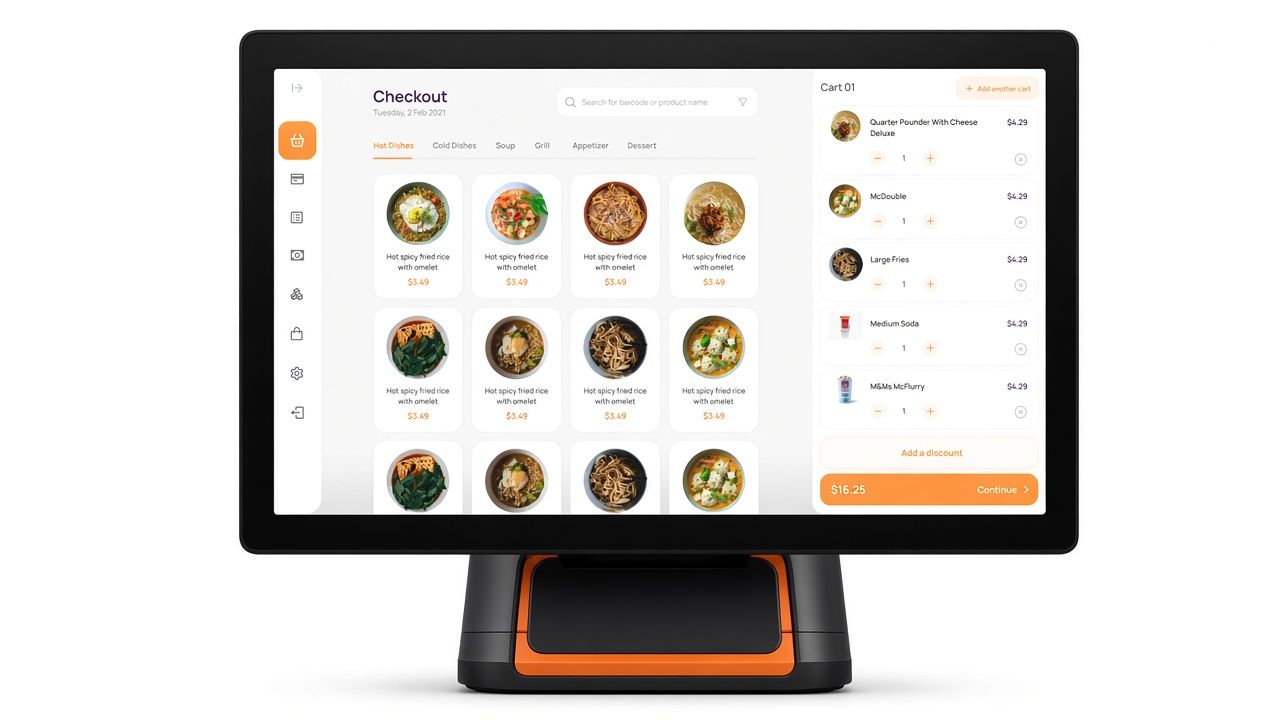
Point-of-sale system for retail and restaurants with real-time order sync across terminals, part of the KIO Store ecosystem.
- Role
- Full Stack Developer
- Year
- 2023
- Stack
- Django
- Python
- PostgreSQL
- Socket.io
- React
- React Native
The problem
Retail counters and busy restaurants cannot afford a POS that “mostly works.” Orders must appear on every relevant terminal immediately, stock must not drift when two cashiers sell the same item, and peak hours punish any architecture that blocks on slow round-trips. KioPOS was built inside the KIO Store ecosystem to give local businesses a reliable digital counter — and to connect with KioSO, the self-ordering companion.
Business requirements
- Cashier and staff interfaces for fast ticket creation
- Product, category and inventory management
- Role-based access for admins, cashiers and operators
- Multi-terminal synchronisation so stations stay consistent
- Integration path with the KioSO self-ordering app
- Sales visibility for managers without compromising checkout speed
My role
As a Full Stack Developer at KIO Store I contributed to backend services and interfaces for KioPOS / KioSO: Django and PostgreSQL services, REST APIs, Socket.io-powered sync, React / React Native surfaces and CI practices around the codebase. The system runs in production environments for real shops; demos are available on request rather than as a public sandbox.
Technical challenges
- Consistency under concurrency — two terminals must not invent conflicting stock or ticket states. PostgreSQL transactions sit at the centre of truth.
- Real-time fan-out — kitchens and counters need push updates; the socket layer notifies, it does not replace the database commit.
- Peak-hour latency — checkout UI and APIs have to stay responsive when order volume spikes.
- Role separation — operators, cashiers and admins see different capabilities on shared hardware.
- Companion app integration — self-ordering (KioSO) must create tickets the POS understands without special-case chaos.
Architecture and choices
KioPOS terminals (React) ──┐
KioSO self-ordering ───────┼──► Django / PostgreSQL API
Staff / admin tools ───────┘         │
                                     ├──► Socket.io gateway (events after commit)
└──► Auth / RBAC- Django + PostgreSQL for relational integrity around products, tickets and stock (why Postgres here)
- Socket.io for post-commit events across terminals
- React / React Native for counter and mobile-adjacent interfaces
- GitLab CI/CD for a repeatable delivery path
Implementation approach
- Persist first, broadcast second — every live update traces back to a successful write
- Tune the queries and payloads used on the checkout path before polishing secondary screens
- Encode roles on the server; the UI only mirrors them
- Treat reconnect/resync as a first-class flow, not an edge case
Results
KioPOS is used in production retail and restaurant contexts within the KIO Store ecosystem. Public download links are not published here because the product is deployed for business customers rather than as a consumer store app. Measurable internal KPIs (tickets/minute, uptime percentages) stay with the company; this case study does not invent them.
Lessons learned
- Real-time UX without a strong transactional core becomes a debugging nightmare
- POS performance is a product feature, not an infrastructure afterthought
- Self-ordering and cashier flows must share one ticket model
- Production constraints (LAN quality, printer quirks, shift changes) shape the backlog as much as feature ideas
KioPOS reinforced a bias I still carry: for money and inventory, boring relational integrity beats fashionable stacks.