AI-assisted language learning
Intellinguo
Generates personalized English for Specific Purposes courses from an AI placement test and a learner needs analysis.
- Role
- Creator · Master’s graduation project
- Year
- 2024
- Stack
- React
- React Native
- Node.js
- MongoDB
- Firebase
- JavaScript
The problem
English for Specific Purposes (ESP) — English for law, engineering, healthcare and similar fields — is hard to deliver at scale. Generic courses ignore the learner’s profession; fully manual tutoring does not scale. Intellinguo asks whether an AI-assisted pipeline can generate a personalised ESP path from a placement signal and a needs analysis.
Context and requirements
Intellinguo was created as my Master’s graduation project in Information Systems Engineering (Abdelhamid Ibn Badis University). Goals:
- Assess level with a dynamically generated placement test
- Capture professional context through a needs analysis
- Generate modules, lessons and exercises adapted to field and level
- Offer web and mobile access with a clean learner UX
- Persist accounts and progress with a managed backend
This is an academic / prototype product, not a claim of a funded commercial SaaS with verified learning-outcome statistics.
My role
I was the creator: product concept, architecture, implementation of web and mobile clients, backend wiring, and integration with AI text generation for tests and course material. Supervisors and academic requirements shaped the research framing; engineering execution was mine.
Technical challenges
- Prompted generation that stays structured — models can ramble; the app needs modules, items and assessments in predictable shapes.
- Placement → profile → syllabus — three stages must hand off cleanly or the personalisation story collapses.
- Auth and progress across web and mobile without building a full custom auth stack for a thesis timeline.
- Honest UX — show learners what was generated and how to continue, without pretending the AI is a human teacher.
Architecture and choices
Web (React) ────┐
Mobile (RN) ────┼──► Node/Express services + AI generation calls
└──► Firebase Auth / Firestore (accounts & progress)- React and React Native for dual-surface delivery
- Firebase Authentication + Firestore to move quickly on identity and document storage
- Node.js / Express where custom orchestration around generation was needed
- AI text generation models for placement items and course drafts (provider choices evolved during the project; the architectural idea is “generation behind a server boundary,” not a hard dependency on one vendor logo)
How the learner flow works
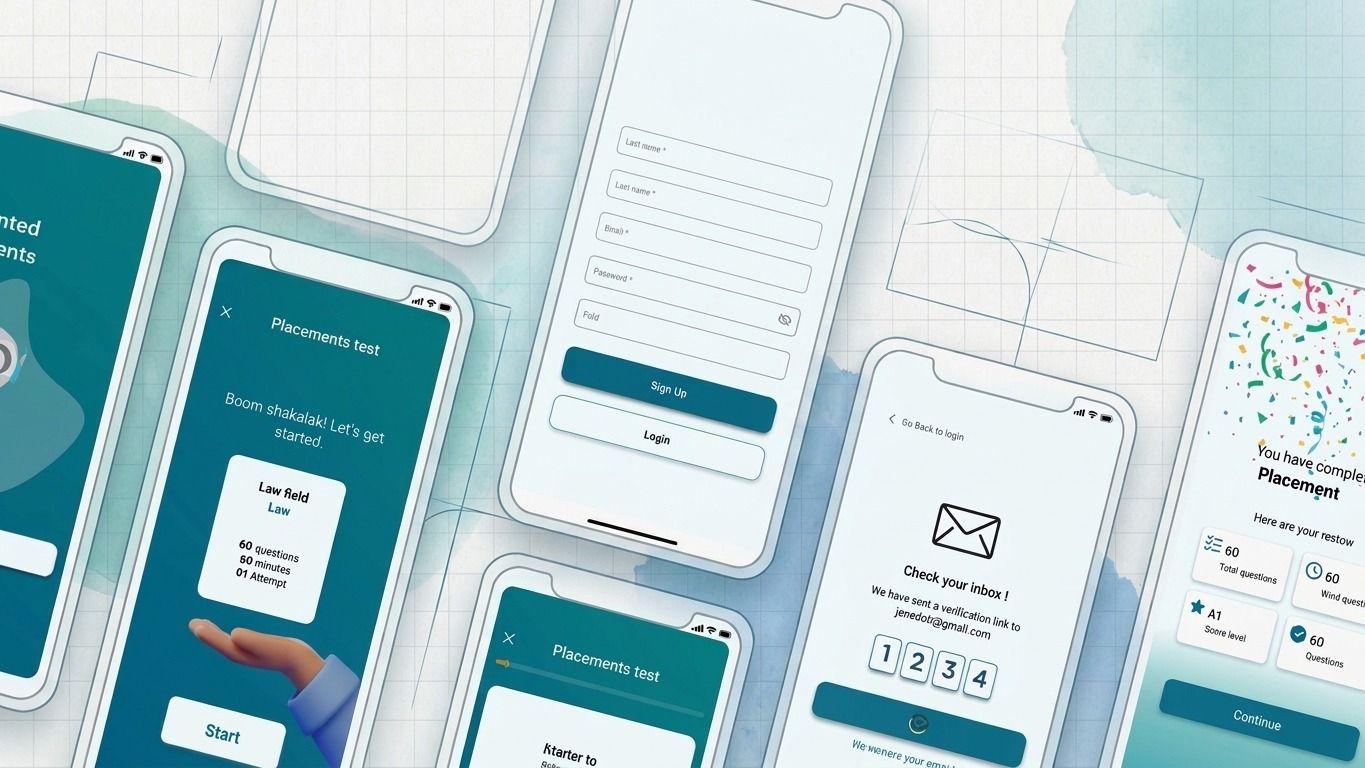
- Placement test — dynamically generated questions probe grammar, vocabulary and comprehension
- Needs analysis — profession, goals and context shape the ESP profile
- Course generation — modules and exercises adapted to level and field
- Assessment — quizzes/tasks to check progress
Results
- Completed as a Master’s project with working web and mobile prototypes
- Demonstrates an end-to-end ESP personalisation pipeline rather than a single chatbot screen
- Demo and documentation available on request (no public consumer store listing)
I do not publish fabricated completion rates or “X% improvement in TOEIC” claims. Those would require controlled studies this project did not run.
Lessons learned
- AI features need schemas and validation, not only prompts
- Academic timelines favour managed auth/data (Firebase) when the research question is personalisation, not infrastructure
- ESP personalisation is a product problem (domain profiles) as much as an ML problem
- Clear “prototype vs production” labelling protects trust — including on a personal portfolio
Intellinguo pushed me from “consume AI APIs” toward designing systems around generation: boundaries, persistence and learner-facing honesty.